Showing posts sorted by relevance for query lab grown. Sort by date Show all posts

Monday, November 27, 2023

Macy's Black Friday Sales: 5 Lab Grown Gemstones

The last of my Macy's Black Friday gift guides will also discuss whether or not, you should buy lab-grown precious gemstones as jewelry. Regular readers of THE SAVVY SHOPPER already know my answer. Yes! Absolutely and without a doubt, if the price is right. When priced fairly (meaning not inflated) you'll get a lot for your money! 

Lab-grown diamonds, sapphires, rubies, and emeralds are as real as natural-grown diamonds, sapphires, rubies, and emeralds. Lab-grown gemstones are physically, chemically, and optically the same as gemstones that form over billions of years in the Earth's mantle or crust. 

Natural gemstones are more expensive than lab-grown gemstones and tend to fetch a higher price on the resale market primarily because they are in higher demand by the public, but as lab-grown gemstones gain more acceptance ... and now as more retailers are entering the market plus manufacturing methods are getting better and cheaper, this is changing. In fact, the greater acceptance and availability of quality lab-grown diamonds are already lowering the prices of mined diamonds produced in nature.

Under a loupe gemologists and jewelers can tell the difference between natural-grown and lab-grown gemstones, yet both are genuine, authentic, real gemstones because chemically and optically they are the same. Both mined and lab-grown stones are the same chemical elements transformed into various gemstones by enormous heat and pressure. Gemologists can also determine where on earth natural sapphires, rubies, and emeralds were formed, as there are tell-tell signs informing them of a gemstone's origins, so it makes sense they can also tell when a  gemstone is lab-grown.

I sound like a broken record in saying, never think of jewelry as an investment but only as a luxury good with huge markups, things of beauty we love but do not need. Except for high jewelry (the apex of rarity and perfection of cut, carat, color, and clarity) or the estate jewelry of a celebrity, you'll rarely get what you pay for your pieces on the resale market.

The great benefit of buying lab-grown gemstones is customers can get bigger gemstones with higher color grades and few inclusions for far less money. They cost at least 1/3 less than natural stones. Short of a cartel forming, I predict prices will continue to drop.

Whether buying lab-grown or natural gemstones, we still need to ensure we're getting value for a good stone based on cut, carat, color, and clarity. 

For this reason, I'm a big fan of Macy's for mid-priced jewelry that ordinary people can afford, and I'd be over the moon to have any (or all😍) of the five 14k gold large sapphires, rubies, emeralds, or diamond sparklers featured here today. OMG, I live at the right time when huge gemstones can be grown in a lab! Dear Fairy Godmother, gimme!!!!!

Final thought: Black Friday sales come and go. If you miss this one, wait for another promotion to come around. They'll run all season and several times of the year!


You may also enjoy:

Monday, May 11, 2026

Michael Gabriels Lab Created Diamond Jewelry

Michael Gabriels lab-grown diamond ring
Diamonds over 2 carats increase in price exponentially, not linearly, because eye-clean, bigger diamonds are rarer and in demand. The jewelry industry uses the term magic sizes to describe the price jump at round numbers that occur at .05, 1.00, 2.00, 3.00 carats and up. If you buy a natural diamond ring slightly below the round numbers, for example, at 2.95 carats, you’ll pay less but get the same effect as a 3.00 carat diamond ring.
Nowadays, people who desire bigger carats are considering lab-grown diamonds for at least 50% less than the cost of natural diamonds of the same size and quality. Lab-grown diamonds are real diamonds. Just like natural-grown diamonds, lab-grown diamonds are pure carbon arranged in a crystal lattice. They have the exact same chemical, physical, and optical properties as natural diamonds. The difference between the two is their origins. Natural diamonds are created over billions of years in the earth, while lab-grown diamonds are created in weeks in a laboratory using advanced technology that mimics the natural geological process of diamond formation. 

Do you want to know how lab diamonds are created? Two methods are used: High Pressure High Temperature (HPHT), which mimics the Earth’s mantle, and Chemical Vapor Deposition (CVD), which uses carbon-rich gas to grow diamond crystals atom by atom. Both methods produce 100% real diamonds. HPHT produces high-quality, often larger crystals and intensely colored diamonds with strong, consistent crystals, while CVD offers greater control, producing exceptional clarity and larger, high-quality, colorless stones such as pure type 2a (IIa) diamonds (i.e. diamonds without metallic inclusions, which are very, very rare in natural diamonds). Only an expert with a spectroscopy in a laboratory can tell a natural diamond and a lab diamond apart. Natural diamonds usually contain small amounts of nitrogen gas that become incorporated into the diamond structure. UV light (fluorescence) can highlight the growth structure of the diamond being tested. Lab-grown diamonds can also be identified by the types of inclusions they might show. CVD, HPHT, and natural diamonds will all have their own distinctive inclusions. Type 2a diamonds produced by the CVD method are the most chemically pure type of diamond, containing no measurable nitrogen, boron, or metallic impurities. They have exceptional transparency and brilliance, comprising less than 2% of gem-quality diamonds. Of course, that would add to their expense.

Often, you pay 50%-70% less for lab-grown diamonds, which usually have better color (D-F) and clarity (VS1) than natural diamonds. In other words, customers get a bigger, cleaner stone for less money. More sparkle! Natural diamonds fetch a higher resale value. But jewelry isn’t an investment, and you should only think of it as a luxury buy, since you’ll usually lose money by selling your jewelry.

Lab-grown diamonds are lowering the price of both natural and lab diamonds as more retailers enter the market and more people buy them.

Michael Gabriels, a 3rd-generation New York jeweler at 46 Howard Street in Soho specializes in lab-grown diamond jewelry with stellar craftsmanship, beautiful design, and good reviews for attentive customer service. Good craftsmanship is vital. You want to buy excellent cut diamonds. In a tennis bracelet or necklace, you want all the diamonds to have matching color and clarity. With regular promotions, you can also score a deal.
Lab-grown diamond jewelry isn’t cheap, but it’s sustainable and considered a better value because you can get more carats and better color and clarity for a lot less moola! No longer must customers spend 5-figures to buy a bigger or cleaner carat diamond ring, bracelet, or pair of earrings!

You may also enjoy:

Sunday, February 9, 2025

#Shorts: Jeweler Terry Quinn's 5 Ways to Save On Lab Grown Diamonds


As stated again and again on THE SAVVY SHOPPER, lab-grown diamonds are physically, chemically, and optically the same as natural (mined) diamonds. Nowadays the process of growing diamonds in a lab has gotten so good that jewelers and customers alike can't tell them apart. If diamonds are grown in a lab, it must be stated so on the diamond because it is so difficult to tell them apart.

Note that lab-grown diamonds cost far less than natural diamonds and therefore don't have the resale value but you should never buy diamonds as an investment anyway as you'll rarely if ever get what you paid for them. Diamonds are a luxury purchase, things of beauty, not an investment.

Today I'm sharing a YouTube video by a jeweler who has a brick-and-mortar store in Woodbridge, Virginia. Jeweler Terry Quinn expertly explains how to save money when selecting diamonds. Today's tips focus exclusively on buying lab-grown diamonds detailing his 5 tips on saving the most money when buying them. 
Worth a listen as I can't summarize his professional advice any more succinctly. (Remember jewelers must look at and buy a lot of diamonds to have stock for their customers.)

The first tip I learned from Terry today is to go with IGI ratings when buying lab-grown diamonds and GIA ratings when buying natural-grown diamonds. IGI and GIA are both reputable diamond grading institutions that use advanced technology and skilled gemologists to certify diamonds but until the perception changes GIA is still the most trusted for natural diamonds. GIA grades fewer lab-grown diamonds than IGI. Lab-grown diamonds will be more expensive and the selection of diamonds less if rated by GIA.

A 2nd tip I learned today was the 2 ways of creating lab diamonds CVD (chemical vapor deposition) and HPHT (high pressure high temperature) have caught up with each other. Both methods are effective in creating high-quality, authentic diamonds, identical to those found in nature. Until recently HPHT lab-created diamonds were whiter and they continue to cost more because of perception leading to their greater demand.

You may also enjoy:

Thursday, April 30, 2026

Celebrities In Diamond Stud Earrings

Photo: here- Click to enlarge photos you want to see.
A luxury item I covet but will never buy is a relatively huge 4+ carat pair of diamond stud earrings. 4-carat diamond studs can cost anywhere from $30,000 - $50,000+ for natural diamonds. Prices are determined by cut, carat, color, and clarity. Customers might consider G-H/SI or F-G/VS, which are of decent quality.
Well, that’s a lot of moola for a single piece of jewelry, isn’t it? Obviously, I was born into the wrong class in society! But, you know what? I will still indulge my love of diamond stud earrings on this blog!
Let’s do a roundup of celebrities who are lucky enough to either work in lucrative fields, or are born into families of wealth, or can borrow their jewelry from famous designers. I’d be fine and dandy with borrowing jewelry! Wearing diamonds without having to buy them is a fabulous deal!
Not all these famous ladies are wearing the biggest diamond studs. Some may even be lab-grown diamonds or not diamonds at all. Only they know.
I wonder if Jennifer Lopez and Angelina Jolie borrowed their diamond studs to attend an awards show? Kelly Clarkson may have treated herself for all the shows and TV spots she does.
Michelle Williams, Michelle Obama, Judge Judy, and Simone Biles likely own the diamond studs they're wearing. All have had enough success to buy them.
Kylie Jenner and Hailey Bieber
Diamond studs of all sizes look great on everyone of all ages in all professions. What’s more, lab-grown diamonds are making diamond stud earrings more accessible to average wage earners, and the technology is improving all the time. Still not cheap, but diamond prices, both natural and lab-grown, are falling! Since 1st on the market, lab-grown diamonds have decreased by as much as 75%! Lab-grown diamonds are physically, chemically, and optically identical to gemstones formed over billions of years in the Earth. The only difference is their origin ... they are created in a laboratory, and only a jeweler using a special loupe can tell the difference.


Diamonds over 2 carats increase exponentially in price. Lab-grown white sapphires in 925 silver are a winning substitute for diamonds if you covet bigger stones without breaking the bank.

It’s all beautiful eye candy to us glitter-lovers!

You may also enjoy:
Benefits Of 10 Popular Diamond Cuts
Which Diamond “C” is the most important?
The Cullinan Diamond In The Crown Jewels
A Heart And Arrows Cut Diamond: What Is It?

Wednesday, March 18, 2026

Admiring 2 Harry Winston Diamond Rings

Another day, another eye candy blog. Let's browse: Here are 2 gorgeous Harry Winston diamond rings average wage earners can admire, yet likely not afford to buy. Even if consumers have the money in the bank, it would be unwise to spend it on luxury items like high-end jewelry rather than on necessities, emergencies, or retirement. But looking, ooing, and ahhing are free. So here we go!

The first ring is crafted in platinum; set with a 12.55-carat step-cut emerald, in a D-color that is internally flawless. The main diamond is flanked by 2 tapered baguette diamonds. The cost depends on the carats, color, and clarity a customer selects if buying it directly from Harry Winston. Both rings are available, with consumers choosing their center diamond.

Ring number 2 is crafted in platinum; set with a 6.01-carat pear brilliant-cut diamond, with E color and VS2 clarity; and it is also flanked by two baguette-cut diamonds. Once again, it’s available and customizable at Harry Winston’s, but Fortuna auctioned this 6.01-carat diamond ring for $187,000.

Oh, what if an average earner loves, loves, loves these beautiful diamonds as much as I do, but could never justify a Harry Winston purchase?

As I always say, "First a dreamer, then a realist!" Use the Harry Winston rings as inspiration and be willing to make some compromises to fit your budget! So what is a practical person who isn’t one of the new billionaires in our country to do?

Consder lab grown diamonds costing considerable less!
Lab-grown gemstones are physically, chemically, and optically the same as gemstones that form over billions of years in the Earth's mantle. Be flexible on carat size, color, and clarity, and switch from platinum to 18k or 14k gold to lower costs. The benefit of gold over platinum is that the ring can be resized to fit a changing finger size over time. The 👆lab-grown pear-shaped diamond on the left is 2 carats in 18k gold, priced at $2,424.10, and it, too, is gorgeous!

For the emerald cut ring, this lab-grown diamond ring to the right👉 is without the side baguettes for $1,979.25. Still, if you yearn to dupe the Harry Winston design at a higher price, another option is here. Research all sellers thoroughly before making any purchases.

On a jewelry budget, perhaps rings are the best splurge, because you can admire their beauty while you wear them, unlike a necklace that requires standing in front of a mirror. You catch the sparkles of a ring as you toss your hand around!

Angara
Although much less than Harry Winston, $2,000+ for jewelry isn’t exactly cheap either, is it? If you’re simply looking for bling to wear without investing weeks of salary, there are yet more compromises you could make. You could buy lab-grown white sapphires, which are inexpensive and crafted in 925 sterling silver, which is still categorized as fine jewelry. Sterling silver is softer than gold, so you wouldn’t want a sterling silver engagement ring
 that you might wear daily, banging it around. Do. Not. Accept. That fiancée of yours must work a little harder! Sterling silver is a fine metal for necklaces, earrings, and rings you wear mindfully when you have few chances of banging it. Moreover, it's wise to take lower-priced jewelry that you can afford to replace on vacation.
Italo rings
Italo is one of several jewelry companies making lab-grown white sapphires in 925 sterling silver. With its ongoing deals, a buyer can score Harry Winston dupe rings at $70 - $100. Decent quality for the price.

Even so, I’m thinking if my ☆・*Fairy Godmother☆・* were to ever appear, she’d procure those 2 Harry Winston rings for me. I know she would, and I’m waiting! Are those fast twinkling lights I see, you know, the kind when a body holding a wand👤👗 materializes out of thin air?😛

You may also enjoy:

Tuesday, July 12, 2022

Let's Talk Diamonds, White Sapphires And Moissanites

Well Happy Birthday to me!💟🎉

I love gemstones, I think for the right reason. Not for their monetary value but for their connection to mother nature wherein they are created over billions of years ... combined with the modern artistry of wo/man whose skillful hands find, cut, and polish them to best show off their exquisite beauty.

For my birthday I got a set of the huge white gemstones I covet, namely a 4-carat brilliant-cut diamond eternity ring and matching 4-carat diamond stud earrings🤥 ... well to be truthful, not exactly diamond gemstones, but white sapphires. Remember my motto? First a dreamer, then a realistic!

Diamonds would cost a fortune, about $110,000+ for the diamond ring and around $33,000 for the stud earrings. Frankly, it's a foolish sum of money for a regular person to spend.

Although there are distinct differences in shine between diamonds and other white gemstones (a/k/a diamond alternatives), such as white sapphire and moissanite, the latter two are gorgeous substitutes for the wildly more expensive diamonds, so a gal won't have to hock her home nor do without her sparkle!

Photo: Italo Jewelry
White sapphire (corundum, a 9) and moissanite (silicon carbide, a 9.25) are right behind diamonds (carbon, a 10) on Moh's Scale of Mineral Hardness and therefore durable to set in rings. 
What follows are reasons you might consider white sapphire or moissanite over a diamond when buying a bigger stone ... and I'll briefly contrast their appearances.

The only reason to not buy a diamond is its greater expense IMHO. The big stones over 2 carats put too many zeros on a credit card which would send many of us into debt! In comparison to diamonds, white sapphire and moissanite gemstones are cheap, especially for a big size. All 3 white gemstones (diamonds, white sapphires, and moissanites) have a lovely sparkle, yet they sparkle differently.

In terms of brilliance (white sparkle) and fire (color sparkle), a diamond outshines white sapphires and has warmer flashes of light (a/k/a glitter; shine) than both white sapphires and moissanite which both have a cooler tone. Brilliant-cut diamonds have a rainbow of shine. White sapphires have a grey or silvery sparkle. Compared to diamonds, moissanite, too, has a cool, bluish brilliance and compared to white sapphires, more fire.

Don't buy a ring gemstone below an 8 in hardness if on a budget as you might have to replace it.

Moissanite's high refractive index (how light bends and passes through a stone) will make it sparkle across a room like no other gemstone, so if you're looking for a huge wow factor (like flashing people across a room😄), you can't go wrong with moissanite. 

Like diamonds, diamond alternatives can be either natural (white sapphire) or lab-grown (white sapphire and moissanite). There are enough white sapphires in nature to mine, whereas moissanite is so rare that all moissanite in jewelry is lab-grown. Since white sapphires can be either natural or lab-grown, the seller is required to state which one you're buying. My birthday ring and stud earrings are lab-grown white sapphires, which doesn't bother me as I know what I'm getting and have spent less money. Lab-grown gemstones are chemically and physically identical to the gemstones created in nature. They are less costly due to lower demand and production costs.

Each of the 3 gemstones has its own unique beauty.
With a good stone cut and jewelry design, you'll enjoy wearing the less in-demand stones without going broke, and only a jeweler will detect which of the 3 is on your finger, neck, or ears. I'm getting loads of compliments and having fun with my great big blingy stones that don't cost a fortune!

Critics (usually people who sell diamonds) will tell you that white sapphires and moissanites don't hold their value like diamonds, and yet if you haven't paid an arm and a leg for them, what do you care? What's more, jewelry isn't an investment as you'll rarely make but often lose money when reselling pieces. Luxuries, including jewelry, are things of beauty, never investments!

Another negative you'll hear is that diamond alternatives look fake. But they don't if you expand your idea of beauty. Remember: I love all gemstones! White sapphires and moissanites only look fake if buyers try to pass them off as diamonds. They don't look fake as white sapphires and moissanites!!
Girrrlll, can't we love all 3 stones!?🙂

Monday, December 15, 2025

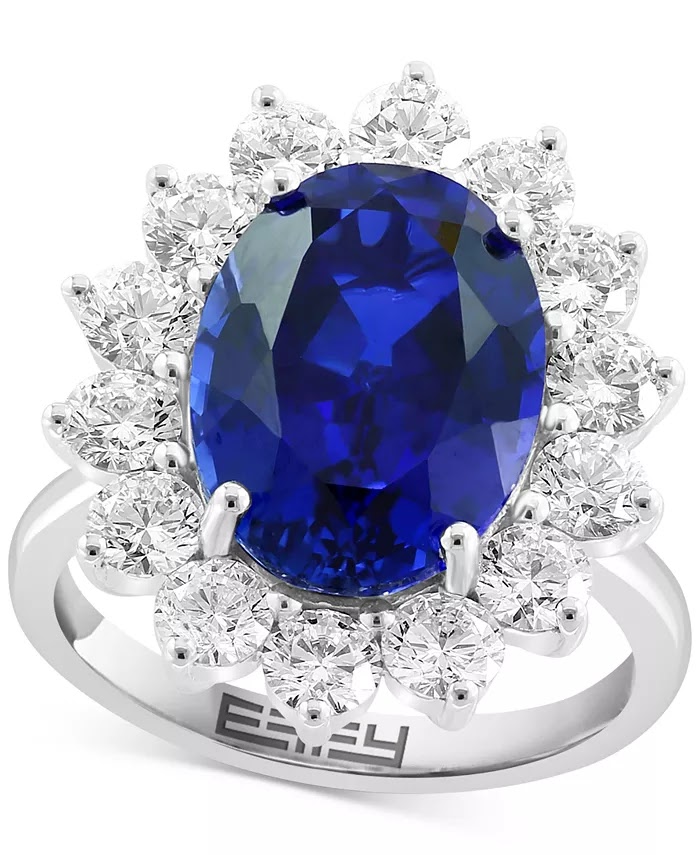
Let’s Discuss Effy Jewelry

Effy on its website and Macys
Effy sells its jewelry on its own website, by appointment at its headquarters in New York’s diamond district and at major retailers like Macy’s, Saks 5th Avenue, Belk, JC Penny and Nordstrom Rack. They also set up international boutiques on cruise ships where I suggest you don’t make impulse buys on big ticket items you may regret later!

Effy has an eye for beautiful design on commercial grade fine jewelry. Customers are not buying or paying for top-grade or heirloom quality diamonds, sapphires, rubies or emeralds. You do get real nature-grown or lab-grown gemstones and real 14k gold at reasonable costs that people with jobs can save up for to purchase. Certainly not cheap, but mid-priced fine jewelry.

You’ll get the most attractive prices at Macy’s and Belk as these two department stores frequently offer the best promotions. You can put a piece of jewelry on a wish list, then wait for the higher discounts of 25% - 30% off -- the ideal time to ponce!

Two causes increased the price of jewelry in recent years: The price of gold rose, and the Trump tariffs put a tax on diamonds. 

Consider lab-grown gemstones if you want gemstones bigger than 2 carats because the price of over 2 carats increases exponentially. Lab-grown gemstones are physically, chemically, and optically the same as earth-grown gemstones. They cost less partly because presently people will pay more for natural-grown gemstones. In the future with wider acceptance, this will likely change, and well-known jewelers have began setting their collections in gemstones of both origins. Never buy jewelry for its resale value as jewelry is a luxury buy and not a true investment. Usually we lose money by reselling jewelry.

Along with 14k gold, Effy sets some of its jewelry in 18k gold and with gemstones over 2 carats for high rollers with deep pockets. In mid November Effy annually has a trunk show at Macy’s Herald Square featuring its higher priced biggest gemstones. I attended one year, and it was fun trying them on! I advise customers to shop mindfully at such special events. Don’t break the bank because large, gorgeous gemstones are sparkling in your face!

Bracelets, earrings and rings cost less. Necklaces tend to be the most expensive piece in a set because more gold and/or gemstones are used to make it. On a budget, you can usually buy the earrings and matching ring for less than the cost of a necklace. You’ll get just as much if not more joy out of wearing the sparklers that fit your budget!

Finally, if you buy classic pieces that are versatile, you can wear them daily ... and to fancy galas. Signiture pieces tend to stay in a box. After you splurge on a luxury item like jewelry, you should get a burst of endorphins every time you look at it on your neck, wrist, finger, or ears. Get your money’s worth by tossing out the box and wearing any jewelry you buy!


You may also enjoy:

Wednesday, October 4, 2023

Diamond Prices Are Crashing

As much as I love jewelry I've always known the price of gemstones is arbitrary to a great extent. Jewelry is as much of an overpriced luxury item as Hermes handbags, Manolo Blahnik shoes, or Dior pants and coats. They cost what consumers are willing to pay for them. Never think of luxury items as investments but to be enjoyed as things of beauty only. The value of luxury goods is driven by want not need. If you covet investments, take your money to an investment firm to buy stocks, bonds, and mutual funds, where you'll earn returns on your portfolio. You're lucky to break even by reselling luxury goods after you subtract a 15% - 20% commission.

Photo: That Guy Osiris - I'll take them!
So I'm happy to report an exciting development in the diamond market! In 2023 diamond prices are tumbling down -- about 23% for 1-carat stones and about 15% for 3-carat stones -- according to experts who watch diamond prices such as That Guy Osiris, an ex-diamond trader who has a YouTube channel. 

The reasons for the decline in diamond prices are several: 

(1) Monopoly diamond sellers such as DeBeer aren't as powerful as they once were in setting diamond prices high combined with limiting the supply of gemstones on the market. 

Photo: istock
(2) Nowadays the demand for diamonds is less. Not every bride in 2023 desires an engagement ring. Some wish to put their $7,000 - $15,000 earnings elsewhere such as for a downpayment on a house or car. Millennials are more interested in spending on travel and experiences than buying diamond rings.

(3) A main reason why the price of diamonds is sinking is the greater acceptance by the public of lab-grown diamonds which cost about 1/3 less than diamonds mined in nature. Diamonds created in a lab are chemically and optically identical to natural diamonds.

(4) The process of making laboratory diamonds is getting better and cheaper all the time, and more companies including jeweler James Allan are offering them. According to Liberum Capital Markets, about 25% to 35% of diamonds sold to customers today are lab-grown diamonds.

Photo: That Guy Osiris
5) That Guy Osiris says that industry leader DeBeers is responding by discounting its prices for 2 - 4 carat rough natural diamonds. Recently prices for uncut natural diamonds have dropped from $1,400 a carat to $850 per carat to be competitive with lab-grown diamonds.

All of this is a win, win, win for customers! If diamond prices keep falling, one day I'll be able to afford my fantasy 4-carat stud diamond earrings (that's 2-carats each ear, sister!!), my 20-carat diamond blingy tennis bracelet, and my 5-carat diamond solitaire ring ... no engagement needed!

Diamonds By Bonnie - has an Instagram and a YouTube Channel
I don't care one iota about the lesser monetary value of lab or natural stones as long as I'm not charged for it. Just give this glitter-loving girl her diamonds! I'll start with that big brilliant round diamond at the top of the blog and the pear-shaped diamond ring at the bottom! We
 can add my fantasy diamonds to my collection later.😉😂

If in the future diamonds cost less, would you value them less?

Tuesday, June 2, 2026

What Makes Green Diamonds?

After writing last Thursday's blog, I got curious about green diamonds. I don’t recall ever seeing one. This might be because they make up less than 0.1% of all fancy-colored diamonds on earth. After red, green diamonds are the 2nd rarest diamonds. Unlike most diamonds that get their colors from chemical impurities entering their atomic structure, green diamonds get their color from natural radiation. Over millions of years, alpha and beta rays emitted by radioactive minerals knock carbon atoms out of place in the crystal structure, changing how the stone absorbs light. In other words, radiation exposure creates carbon atom vacancies. This vacancy defect, also known as the GR1 center in a diamond, causes the green color.


According to Only National Diamonds, radiation from alpha particles usually only penetrates a few micrometers deep, leaving a shallow green "skin" on rough stones. Diamond cutters must plan and facet the gem with expert precision to evenly distribute this color throughout the stone. It may explain why we see more radiant cuts in this fancy colored gemstone. The radiant cut’s faceting maximizes light reflection, which intensifies and saturates the color of the stone, making it appear more vivid.

A very few green diamonds are also colored by more complex defects involving nitrogen, hydrogen, or nickel.

The world’s natural green diamonds come from South America and Africa. Nowadays, laboratory irradiation can also produce green diamonds. It’s challenging to tell natural-grown and lab-grown green diamonds apart. Both are real diamonds. It’s unlawful to sell lab-grown diamonds without transparency.

The scarcity of green diamonds makes them very pricey. Just like other colored gemstones, color is the most important of the fancy diamond Cs (followed by cut, carat, and clarity) in determining value. As their color becomes more saturated and vibrant, prices rise dramatically. Based on their GIA color intensity grade for a 1-carat stone, a Fancy Green color costs from $50,000 - $100,000; a Fancy Intense Green costs between $150,000 - $200,000, and a Fancy Vivid Green costs $300,000+.

Photo: Wikipedia
The Dresden Green Diamond
The Dresden Green, a 41-carat diamond originating from India’s Golconda mines, is the largest and most famous natural green diamond in the world. It is a chemically pure IIa diamond with VS1 clarity. Frederick Augustus II, Elector of Saxony and King of Poland, paid 400,000 thalers for the diamond in 1741. Perhaps someone should have told Diespach, the court jeweler of Saxony, that fads come and go before, in 1768, he mounted the Dresden Green as an elaborate hat ornament surrounded by 411 white diamonds.😁 Today, it is on display in the Green Vault at Dresden Castle in Germany. The renowned green diamond survived the Seven Years’ War, the Napoleonic Wars, World Wars I and II, its confiscation by the Soviets, who returned it to Dresden in 1958, and the 2019 Dresden Museum heist of royal jewels. Thankfully, at the time of the theft, the Dresden Green was on loan to the Metropolitan Museum in Manhattan.

The Aurora Green (👆top image) is a 5.02 carat Fancy Vivid Green rectangular radiant cut diamond with VS2 clarity. The Aurora Green is surrounded by pink diamonds set in a ring. Found in Brazil, it sold for a wooping $16.8 million, the most expensive price ever paid for a green diamond, at Christie’s Hong Kong in 2016. Chow Tai Fook Jewellery bought it. Without fluorescence, its GIA-rated Fancy Green color is one of a kind!

Photo: Jewelry Point
Personally, I’d rather pay less money to get a bigger, more common white (clear) diamond. Other jewelry lovers may covet uniqueness over size. 

Ultra-rare fancy-colored diamonds are so wildly expensive that customers fork over a ton of moola for a tiny stone, so I wouldn’t buy, but visit them at Tiffany’s New York flagship store or the museums around the world that house them. First a dreamer, then a realist ... and perhaps an adventurous traveler is the way to get more bang for your buck!💚