Showing posts sorted by relevance for query rubies. Sort by date Show all posts

Tuesday, September 4, 2018

Ruby The Scarlet Stone

Photo: Sotheby's - a 6.13 carat ruby for a mere $89,000 -- Gimme!!!

Let's look at the most fiery gem in the jewelry world: A red, red ruby. The other precious stones are diamonds, sapphires, and emeralds. Of the 4 gems, diamonds are the most common in nature, followed by sapphires, rubies, and emeralds in descending order of rarity.

The name ruby literally means red in Latin (from the word "rubens"). Just like their sapphire siblings, rubies consist of the mineral corundum, except rubies get their vibrant red color from trace amounts of the element chromium. (On the other hand, when titanium and iron are added to the corundrum, the resulting blue gem is called a sapphire. Get it?) As corundums, both rubies and sapphires are one of the hardest stones, rating a 9 on the Mohs Scale of Hardness, after diamonds, a 10.

The finest rubies in the world from Burma, now known as  Myanmar rubies, were banned in the United States for 5 years. The ban was imposed to fight an oppressive military regime, plus human rights violations, including child labor in the mines. That ban was lifted in the fall of 2016. The reason why Myanmar (or Burmese) rubies are so prized is due to their desirable hue called "pigeon's blood" -- a vivid red with a hint of blue. 
Photo: Van Cleef and Arpels -- GIMME!!!
Large transparent rubies are rarer and more expensive than diamonds (costing twice as much per carat). Know that (just like sapphires) there are few imperfect rubies in the world, so inclusions in rubies are acceptable as long as they don't affect clarity. "Silk" inclusions are commonly seen in rubies -- they are intersecting needles of the mineral rutile.

As much as I love rubies, I'm not too tempted to buy them these days. Why you may ask? A fine Burmese ruby averages $3,000+ per carat (depending on color and inclusions). But more affordable rubies sourced from other parts of the world (including the USA, Australia and Africa) are often too tiny, cloudy or pink in my humble opinion. What's the point of paying for those? I want a big clean pigeon's blood ruby, don't you? (But not enough to pay the piper, and now I worry about abuses in the mines also. So check before buying.)
Photo: Investmentjewelry - GIMME!!!
In fact, most modern rubies have been treated to improve their color and strength. Treatments include heat, or lead glass filling (into fractures). While this improves the transparency of the stone, it also makes the gem look more expensive than it really is, therefore the information must be disclosed to a buyer and priced accordingly.

But. If you adore rubies feel free to buy a bauble within your budget to dress yourself up. At the end of the day, jewelry is a thing of beauty only and not an investment anyway. So if you love the scarlet stone, get one and wear it to your beating heart's content!


You may also enjoy:
About Morganites
For The Love Of Sapphires  
The Gemstone Chrome Diopside   
Royal Engagement Rings: Let's Take A Look

Thursday, October 16, 2025

Admiring Rubies In The Raw


Today I want to feature high quality rubies in their natural state. I’d be trilled to find such a precious red crystal before it was cut and turned into jewelry. I’m not sure I’d want to cut or polish it. Previously I’ve written about rubies detailing their properties and value, which I’ll link below.πŸ‘‡The main purpose of this blog is to fawn over uncut rubies!

In the jewelry world, rubies are one of the rarest and most coveted gemstones. The red corundum derives its color from traces of chromium. All other colors of gem-quality corundum are classified as sapphires, including pink corundum. Gemologists and jewelers expect a medium to medium-dark red color tone for a gemstone to be considered a genuine ruby
Corundums of lighter coloration are pink sapphires. A ruby's exclusive red color can reach high levels of saturation. Due to their rarity, premium quality rubies are among the world's most expensive gemstones, selling for over $1 million per carat.

Historically, Myanmar (formerly called Burma) was the most renowned source for high-saturation with fluorescence, or "pigeon's blood," rubies. But in 2009 major deposits of high quality rubies were discovered in Mozambique to rival Myanmar rubies. Vietnam and Madagascar also grow similar high quality rubies.


Since there are few gemstone quality high saturation rubies in nature, rubies undergo more treatments than nearly all other gemstones before being turned into jewelry, greatly affecting their market value. Most commercial rubies are at least heat-treated, an accepted practice as long as it’s disclosed and reflected in its retail price. Without treatment there would be few rubies to sell.

A lovely affordable raw ruby bracelet here from an unfamiliar retailer.

Aren’t these blocks of uncut vibrant red gemstones beautiful? Especially when knowing that not all natural ruby crystals are gemstone quality. If you want to know more about gemstone quality rubies, you can click the links below.

If you found a raw ruby would you treasure it or have it cut and polished into a piece of jewelry? 


You may also enjoy:

Wednesday, February 21, 2024

Million Dollar Rubies Sold


Imagine owning massive top-quality rubies! Let's take a look at 2 stones sometimes called the king of gems that were sold in 2023. 

First up is The Sunrise Ruby, a rare Cartier Burmese ruby, set with 2 side diamonds in a platinum ring. Last year it was sold at auction by Christie's from the estate of Austrian billionaire Heidi Horten for $13,055,000, less than predicted due to a bit of controversy that is unrelated to the gemstone's origin. In 2015 Ms. Horten paid $30,300,000 for the ruby. According to Christie's, the price was higher in 2015 due to the back and forth of 2 bidders at the time.

BelowπŸ‘‡are different angles of the cushion shape, brilliant cut Sunrise Ruby. It weighs 25.59 carats.

πŸ”ΊπŸ”»πŸ”ΊπŸ”»πŸ”»πŸ”»πŸ”ΊπŸ”»πŸ”ΊπŸ”»πŸ”ΊπŸ”»πŸ”ΊπŸ”»πŸ”ΊπŸ”»πŸ”ΊπŸ”»πŸ”»πŸ”ΊπŸ”»πŸ”ΊπŸ”»
Mozambique, a country in Southeastern Africa, is emerging as a rich source of premium-quality rubies. Our 2nd gemstone is a Mozambique ruby that fetched $34,800,000 at Sotheby's last year, setting a new record for the price of a ruby. 
Called the Estrela de Fura (Porchugese for Star of Fura) Ruby, at 101 carats uncut, it's both the largest gem-quality ruby ever found, as well as, the highest price ever paid at auction! Cut down to 55.22 carats by gem dealer and cutter Francois Garaude into a cushion shape, this stunning ruby bears remarkable symmetry and balance. It is gigantic, unheated, and clean making it a rare natural ruby. The ruby's pigeon blood color is equal to the celebrated Burmese rubies. Under ultraviolet light, the Estrela de Fura ruby radiates a strong fluorescence. 

In addition to oohing and ahhing, all I can say is a regular person's rubies are very small and flat in comparison!😊

BTW, The Sunrise and Estrela de Fura rubies were acquired by anonymous private collectors. The new owner of Ms. Horten's ruby lives in the Middle East. I always hope these huge ideal gemstones eventually end up in a museum so the public too can see them.

πŸ”ΊπŸ”»πŸ”ΊπŸ”»πŸ”»πŸ”»πŸ”ΊπŸ”»πŸ”ΊπŸ”»πŸ”ΊπŸ”»πŸ”ΊπŸ”»πŸ”ΊπŸ”»πŸ”ΊπŸ”»πŸ”»πŸ”ΊπŸ”»πŸ”ΊπŸ”»πŸ”ΊπŸ”»πŸ”ΊπŸ”»πŸ”ΊπŸ”»πŸ”Ί
And now here are jewels for average people like you and me. πŸ˜› 

BelowπŸ‘‡are smaller, less-perfect rubies from Macy's or Saks. Perhaps not heirloom nuggets, yet they are pretty too, no? Each piece is 1-9/10 carats, a versatile size that can be worn both daily and to galas ... and the cost is more attainable. Remember my motto: First a dreamer, then a realist!


You may also enjoy:

Sunday, February 4, 2024

Georgous Ruby Jewelry But Small & Pricey

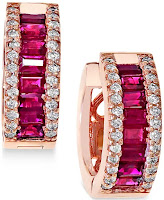
I've had my eye on these Effy rubies and diamonds in 14k rose gold hoops selling on Macy's website for a while because they're classic and gorgeous! I love the rose gold and baguette-cut rubies sandwiched between 2 lines of small round diamonds. But because of the small size of the earrings (mentioned in the reviews) compared to the relatively high price, I don't think we're getting enough for our money even when they go on sale. It isn't the greed of Macy's or Effy (the vendor) in particular that I fault for being so costly. Universally across different retailers, we are now charged more for less than substantial pieces of jewelry. Why?

Lali Jewels (left) and LeVian (right)
Gem-quality rubies (and red gemstones in general) are rarer in nature, therefore rubies tend to cost more per carat than sapphires or diamonds. (Gem-quality emeralds are even rarer so cost more per carat than rubies, sapphires, and diamonds.)

Le Vian (left) and Effy (right)
To be called a ruby the corundum (stone) must be red. Frankly, some of these ruby stones I'm featuring on the blog look more like pink sapphires online, but perhaps they are darker in the retail store? To recite an industry saying, "It's a pink sapphire if you're the buyer and a ruby if you're the seller." Both can be lovely gemstones, just be sure the price matches its color!

The jewelry featured in today's post is beyond cute and so tempting, especially near Valentine's Day. I just can't believe the steep prices of over $1,000 for such slight pieces!😳

Why has dainty jewelry gotten so expensive? One reason is the price of gold is higher so now we're asked to pay through the nose for flimsy pieces of jewelry!

Is it worth it? People must decide for themselves, but if I saved up weeks of salary in exchange for tiny earrings or a thin ring, I'd be disappointed after opening the box regardless of how pretty the design is. Perhaps I'd feel somewhat taken, and clearly, I'd feel I could do more with the money elsewhere.

Macy's in-house brand (left) and Lali Jewels (right)

One way to lower the cost of fine jewelry is to find pieces in 925 sterling silver instead of 14k or 18k gold, suitable for earrings, necklaces, also rings, and bracelets you don't wear daily, i.e., jewelry you don't bang around. Like gold, silver is a precious metal yet softer than gold. I own 2 pairs of earrings (10'' round freshwater pearls and 4-carat lab-grown white sapphires with silver posts. Each durable pair costs under $100.)

Even freshwater pink pearls with tiny marquise-shaped pink tourmaline earrings (below↓) are pricey! Some people love delicate jewelry, but how much are customers willing to pay for it?
Macy's in-house brand (left) and LeVian (right) - all the jewelry is sold on Macy's website
.
Friends, is love ... as in the love of gold jewelry blind? Nowadays are you buying or passing on fine jewelry?πŸ€”


You may also enjoy:

Monday, November 27, 2023

Macy's Black Friday Sales: 5 Lab Grown Gemstones

The last of my Macy's Black Friday gift guides will also discuss whether or not, you should buy lab-grown precious gemstones as jewelry. Regular readers of THE SAVVY SHOPPER already know my answer. Yes! Absolutely and without a doubt, if the price is right. When priced fairly (meaning not inflated) you'll get a lot for your money! 

Lab-grown diamonds, sapphires, rubies, and emeralds are as real as natural-grown diamonds, sapphires, rubies, and emeralds. Lab-grown gemstones are physically, chemically, and optically the same as gemstones that form over billions of years in the earth's mental or crust. 

Natural gemstones are more expensive than lab-grown gemstones and tend to fetch a higher price on the resale market primarily because they are in higher demand by the public, but as lab-grown gemstones gain more acceptance ... and now as more retailers are entering the market plus manufacturing methods are getting better and cheaper, this is changing. In fact, the greater acceptance and availability of quality lab-grown diamonds are already lowering the prices of mined diamonds produced in nature.

Under a loupe gemologists and jewelers can tell the difference between natural-grown and lab-grown gemstones, yet both are genuine, authentic, real gemstones because chemically and optically they are the same. Both mined and lab-grown stones are the same chemical elements transformed into various gemstones by enormous heat and pressure. Gemologists can also determine where on earth natural sapphires, rubies, and emeralds were formed, as there are tell-tell signs informing them of a gemstone's origins, so it makes sense they can also tell when a  gemstone is lab-grown.

I sound like a broken record in saying, never think of jewelry as an investment but only as a luxury good with huge markups, things of beauty we love but do not need. Except for high jewelry (the apex of rarity and perfection of cut, carat, color, and clarity) or the estate jewelry of a celebrity, you'll rarely get what you pay for your pieces on the resale market.

The great benefit of buying lab-grown gemstones is customers can get bigger gemstones with higher color grades and few inclusions for far less money. They cost at least 1/3 less than natural stones. Short of a cartel forming, I predict prices will continue to drop.

Whether buying lab-grown or natural gemstones, we still need to ensure we're getting value for a good stone based on cut, carat, color, and clarity. 

For this reason, I'm a big fan of Macy's for mid-priced jewelry that ordinary people can afford, and I'd be over the moon to have any (or all😍) of the five 14k gold large sapphires, rubies, emeralds, or diamond sparklers featured here today. OMG, I live at the right time when huge gemstones can be grown in a lab! Dear Fairy Godmother, gimme!!!!!

Final thought: Black Friday sales come and go. If you miss this one, wait for another promotion to come around. They'll run all season and several times of the year!


You may also enjoy:

Tuesday, May 8, 2018

Always Buy Good Jewelry Design

Queen Victoria's coronation ring
Queen Victoria had smaller hands then her predecessor, King William IV, so her carnation ring of a large sapphire, rubies and diamonds was made just for her. She left the ring to the Crown. It is part of the Crown Jewels.

Big rare Ceylon blue sapphires are rare in nature, making them expensive. What a shame to cover it up with rubies and close it off with diamonds. I wouldn't do a thing to this ring to preserve history. The ring has much British symbolism, but a better setting would show off the loveliness of all the magnificent top-notch stones.
As commoners much lower on the wage-food-chain, we don't have the luxury of poor jewelry design. A piece of fine jewelry we save up to buy becomes a waste if we don't love and wear it. What's more, many of us can't afford big, perfect stones. So the most important factor to consider is good jewelry design. How the stones are set and arranged matter. 

Don't worry. When you see good jewelry design you recognize it!

And guess what? With good design, less perfect stones can look stunning. A ring sparkles on a finger. Earrings glitter on the ears. A splurge without emptying a wallet is possible for a savvy shopper! So trust your eyes and your gut. Only buy what you love.

Diamonds (made of carbon) rate a 10 on the Mohl Scale of Stone Hardness. Sapphires (blue corundum, a mineral made of alumina and oxygen) and rubies (red corundum) are a 9, while emeralds (made of beryllium) rate an 8. All are hard enough for jewelry. Diamonds are common and plentiful in nature. Emeralds are rarer, followed by rubies, then sapphires. You should buy the gem you love not what costs the most. Why? Because jewelry is not an investment. And diamonds are not rare, but a demand created by marketing, beginning in the 1930s. Once you pay for a diamond ring and bring it home, it loses about half of its value.
The ruby and diamond pendent, belonging to Queen Victoria Eugenie of Spain, a gift from her grandmother, Queen Victoria.
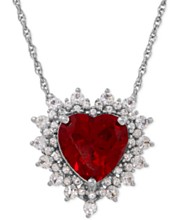
Ruby and diamond pendent neckless created for Macy's. Not nearly as pricey as the Queen's, (the ruby and diamonds are smaller and less perfect),  yet beautiful.
Still  jewelry with good design looks gorgeous. Gems catch the light and sparkle when the work of nature (which takes 1000s of years) is improved by a skillful human hand.


You may also enjoy:
About Morganite
Lovely Freshwater Pearls
Macy's For Fine Jewelry ... Yes Or No?
Royal Engagement Rings: Let's Take A Look

Thursday, November 6, 2025

The 3 Other Precious Gemstones In The Raw


Recently I wrote a blog about raw rubies before they are cut, polished and turned into jewelry. Today I’m posting images of the 3 other precious gemstones in the raw. When we visualize gemstones, mostly we see them as the sparklers they become after craftsmen and jewelers get their hands on them like the above Harry Winston diamond ring. Not how them start or grow in nature, but how they are finished, right? So let's look at a few images of gemstones as they are found in nature.
I. Diamonds are a single element. Formula: C. A diamond is an allotrope of the element carbon. Its structure is a rigid three-dimensional lattice where each carbon atom is bonded to four other carbon atoms in a tetrahedral arrangement. A diamond’s atoms are arranged in a crystal structure called a diamond cubic. The gemstone rates a 10 on Mohs Hardness Scale. BTW: Graphite, charcoal, and diamond are all allotropes of the element carbon.


⋆ ๋࣭ ⭑✧⋆ ๋࣭ ⭑✧⋆ ๋࣭ ⭑✧⋆ ๋࣭ ⭑✧⋆ ๋࣭ ⭑✧⋆ ๋࣭ ⭑✧⋆ ๋࣭ ⭑✧ ๋࣭ ⭑✧⋆ ๋࣭ ⭑✧


The Aga Khan Emerald brooch and
the Chalk Emerald ring

II. Emeralds - are beryls, a mineral. Its formula, Be3Al2(SiO3)6, is colored green by trace amounts of chromium or sometimes vanadium. On Mohs Hardness Scale emeralds rate an 8. They were formed under the most violent of geologic conditions, which is why less than 1% of the world’s emeralds are eye clean. Unlike diamonds, inclusions and surface breaking fissures called  jardins are common and accepted in emerads. 


⋆ ๋࣭ ⭑✧ ๋࣭ ⭑✧⋆ ๋࣭ ⭑✧⋆ ๋࣭ ⭑✧⋆ ๋࣭ ⭑✧⋆ ๋࣭ ⭑✧⋆ ๋࣭ ⭑✧ ๋࣭ ⭑✧⋆ ๋࣭ ⭑✧

The Swedish royal family's Leuchtenberg Sapphire tiara and an unheated Kashmir 9.38 sapphire ring sold by Christie’s

III. Sapphires - are a variety of the mineral corundum. Its formula, Ξ±-Al2O3 consists of the elements aluminum oxide with trace amounts of iron, titanium, cobalt, lead, chromium, vanadium, magnesium, boron, and silicon. Sapphires register a 9 on Mohs Hardness scale. Blue is the most in demand color. When sapphires are yellow, orange, purple, pink, or green they are called fancy sapphires. When corundrms are red, they are rubies, not sapphires.


Gemstones take millions of years for the Earth to produce, or nowadays they can be grown in a lab, but it takes the artistry of human hands to turn these majestic crystals, beryls, and corundums into gorgeous pieces of jewelry. The next time you see a gemstone think of its journey and how many hands went into crafting it into a thing of beauty.


You may also enjoy: